Showing posts with label airplane. Show all posts

Antonov AN 32


The An-32 is basically a re-engined An-26. The launch customer was the Indian Air Force, which ordered the aircraft partly due to good relations between then USSR leader Leonid Brezhnev and then India leader Indira Gandhi. The An-32 is designed to withstand adverse weather conditions better than the standard An-26. The high placement of the engine nacelles above the wing allowed for larger diameter propellers, which are driven by 5,100 hp rated AI-20 turboprop engines, providing almost twice the power of the An-26's AI-24 powerplants. Estimated price for a modernised An-32 version is 15 million dollars
The AN-32 light military transport multi-purpose aircraft can be operated in various climate conditions, including hot climate (up to + 50°C) and from the mountain airfields (up to 4500 m elevation). The main aircraft purpose is to transport cargoes over short and medium range air routes.

It can be used for carrying military personnel, aerial delivery of paratroopers and palletized and non-palletized cargoes.

compiled by XENOCIDE

Mikoyan Gurevich MiG 25 foxbat interceptor


The Mikoyan-Gurevich MiG-25 is a supersonic interceptor and reconnaissance aircraft that was among the fastest military aircraft to enter service. It was designed by the Soviet Union's Mikoyan-Gurevich bureau. The first prototype flew in 1964, and the aircraft entered service in 1970. It has an operational top speed of Mach 2.83 (Mach 3.2 is possible but at risk of significant damage to the engines), and features a powerful radar and four air-to-air missiles. Because of the thermal stresses incurred in flight above Mach 2, the Mikoyan-Gurevich OKB had difficulties choosing what materials to use for the aircraft.


They had to use E-2 heat-resistant Plexiglas for the canopy, and high-strength stainless steel for the wings and fuselage. Using titanium rather than steel would have been ideal, but it was expensive and difficult to work with.
The problem of cracks in welded titanium structures with thin walls could not be solved, so the heavier nickel steel was used instead. It cost far less than titanium and allowed for welding, along with heat resistant seals. The MiG-25 was constructed from 80% nickel steel alloy, 11% aluminium, and 9% titanium.The steel components were formed by a combination of spot welding, automatic machine welding and hand arc welding methods

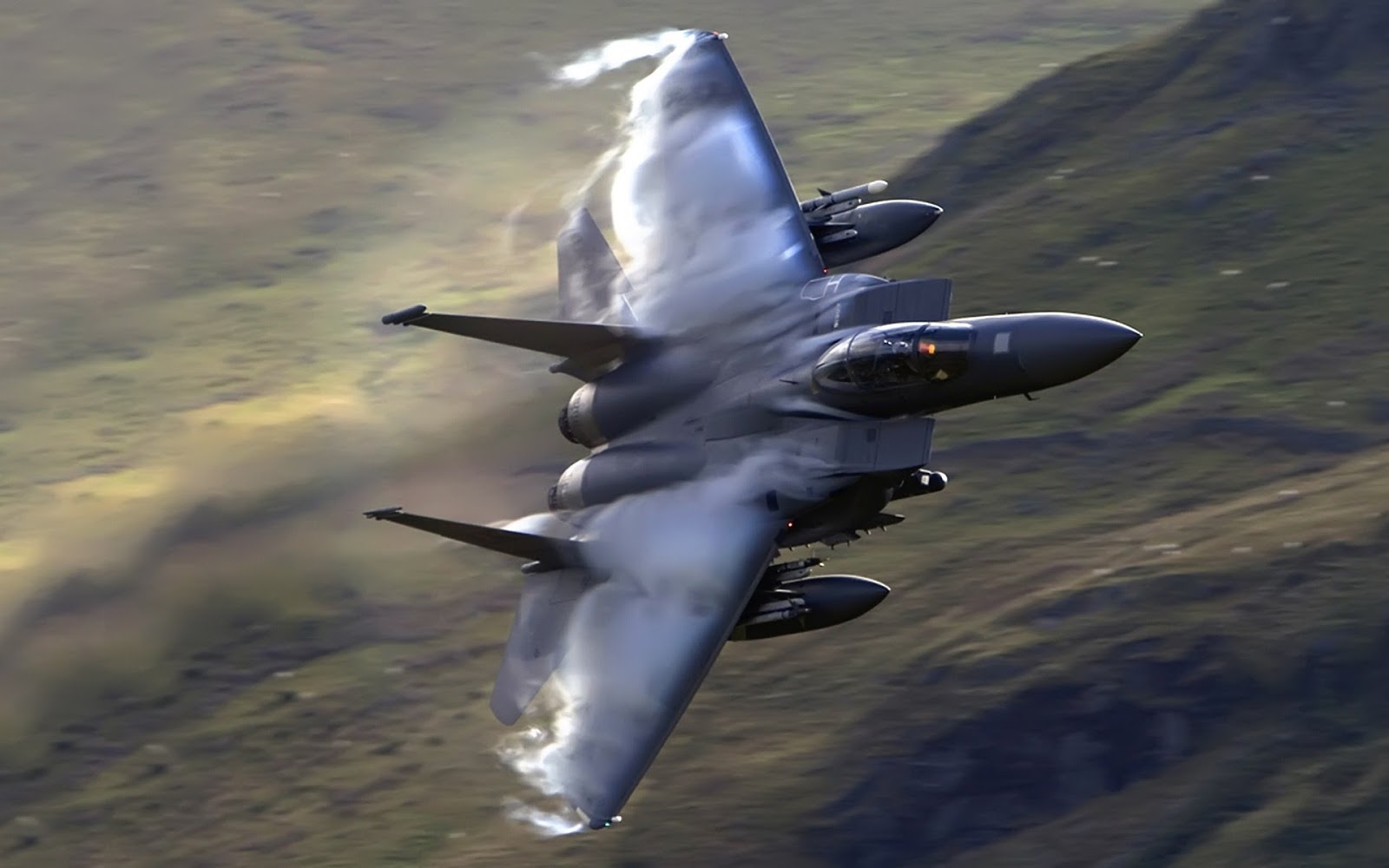
F15 eagle


The F-15 has an all-metal semi-monocoque fuselage with a large cantilever shoulder-mounted wing. The empennage is metal and composite construction, with twin aluminium/composite material honeycomb structure fins with boron-composite skin, resulting in an exceptionally thin tailplane and rudders with all-moving composite horizontal tail surfaces outboard of the fins

The F-15's maneuverability is derived from low wing loading (weight to wing area ratio) with a high thrust-to-weight ratio enabling the aircraft to turn tightly without losing airspeed. The F-15 can climb to 30,000 ft (10,000 m) in around 60 seconds. The thrust output of the dual engines is greater than the aircraft's weight, thus giving it the ability to accelerate in a vertical climb.


The Eagle can be armed with combinations of four different air-to-air weapons: AIM-7F/M Sparrow missiles or AIM-120 AMRAAMadvanced medium range air-to-air missiles on its lower fuselage corners, AIM-9L/M Sidewinder or AIM-120 AMRAAM missiles on two pylons under the wings, and an internal 20 millimetres (0.79 in) M61 Vulcan Gatling gun in the right wing root compiled by XENOCIDE

F14 tomcat


The Grumman F-14 Tomcat is a supersonic, twin-engine, two-seat, variable-sweep wing fighter aircraft. The Tomcat was developed for the United States Navy's Naval Fighter Experimental (VFX) program following the collapse of the F-111B project. The F-14 was the first of the American teen-series fighters, which were designed incorporating the experience of air combat against MiG fighters during the Vietnam War.

The F-14 Tomcat was designed as both an air superiority fighter and a long-range naval interceptor.The F-14 has a two-seat cockpit with a bubble canopy that affords all-round visibility. It features variable geometry wings that swing automatically during flight. For high-speed intercept, they are swept back and they swing forward for lower speed flight. It was designed to improve on the F-4 Phantom's air combat performance in most respects.


The F-14's fuselage and wings allow it to climb faster than the F-4, while the twin-tail arrangement offers better stability. The F-14 is equipped with an internal 20 mm M61 Vulcan Gatling cannon mounted on the left side (unlike the Phantom, which was not equipped with an internal gun in the US Navy), and can carry AIM-54 Phoenix, AIM-7 Sparrow, and AIM-9 Sidewinder anti-aircraft missiles. The twin engines are housed in widely spaced nacelles. The flat area of the fuselage between the nacelles is used to contain fuel and avionics systems, such as the wing-sweep mechanism and flight controls, as well as weaponry, since the wings were not used for carrying ordnance.[17] By itself, the fuselage provides approximately 40 to 60 percent of the F-14's aerodynamic lifting surface depending on the wing sweep position. The lifting body characteristics of the fuselage allowed one F-14 to safely land after suffering a mid-air collision that sheared off more than half of the plane's right wing in 1991.

compiled by XENOCIDE