The FN F2000 is a 5.56×45mm NATO bullpup assault rifle, designed by FN Herstal in Belgium.
The F2000 is a modular weapon system; its principal component is a compact 5.56×45mm NATO-caliber assault rifle configured in a bullpup layout. The F2000 is a selective fire weapon operating from a closed bolt.
The rifle consists of two main assemblies: the barreled receiver
group and the frame, coupled together by means of an axis pin located
above the trigger guard. The barrel group has an integral MIL-STD-1913 Picatinny rail
used to mount optical sights. The frame or lower receiver contains the
trigger group, the bolt and bolt carrier assembly, return mechanism and
magazine well. A removable handguard is installed in front of the
trigger which completes and encloses the trigger guard.
compiled by XENOCIDE
The Boeing F/A-18E Super Hornet and related twin-seat F/A-18F are twin-engine carrier-capable multirole fighter aircraft variants based on the McDonnell Douglas F/A-18 Hornet.
The F/A-18E single-seat and F/A-18F tandem-seat variants are larger and
more advanced derivatives of the F/A-18C and D Hornet. The Super Hornet
has an internal 20 mm M61 rotary cannon and can carry air-to-air missiles and air-to-surface
weapons. Additional fuel can be carried in up to five external fuel
tanks and the aircraft can be configured as an airborne tanker by adding
an external air refueling system.
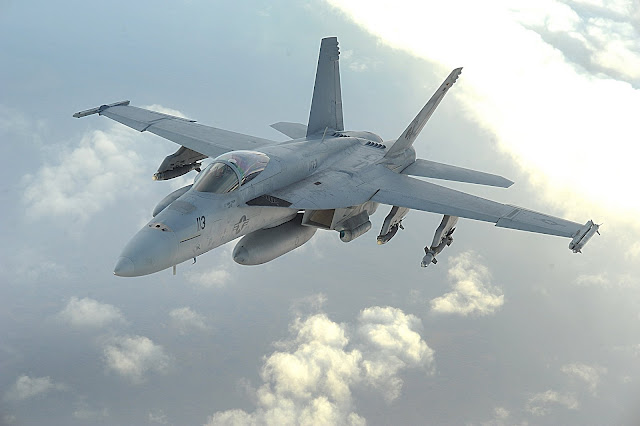
The Hornet and Super Hornet share many characteristics, including avionics, ejection seats, radar, armament, mission computer software, and maintenance/operating procedures.The Super Hornet is largely a new aircraft at about 20% larger,
7,000 lb (3,200 kg) heavier empty weight, and 15,000 lb (6,800 kg)
heavier maximum weight than the original Hornet. The Super Hornet
carries 33% more internal fuel, increasing mission range by 41% and
endurance by 50% over the "Legacy" Hornet. The empty weight of the Super
Hornet is about 11,000 lb (5,000 kg) less than that of the F-14 Tomcat
which it replaced, while approaching, but not matching, the F-14's
payload and range. As the Super Hornet is significantly heavier than the "legacy" Hornet, the catapult and arresting
systems must be set differently. To aid safe flight operations and
prevent confusion in radio calls, the Super Hornet is informally
referred to as the "Rhino" to distinguish it from earlier Hornets. (The
"Rhino" nickname was previously applied to the McDonnell Douglas F-4 Phantom II, which was retired from the fleet in 1987.)
The Super Hornet, unlike the previous Hornet, is designed so it can
be equipped with an aerial refueling system (ARS) or "buddy store" for
the refueling of other aircraft,filling the tactical airborne tanker role the Navy had lost with the retirement of the KA-6D and Lockheed S-3B Viking
tankers. The ARS includes an external 330 US gal (1,200 L) tank with
hose reel on the centerline, along with four external 480 US gal
(1,800 L) tanks and internal tanks, for a total of 29,000 lb (13,000 kg)
of fuel on the aircraft.On typical missions a fifth of the air wing is dedicated to the tanker
role, which consumes aircraft fatigue life expectancy faster than other
missions.

Initially, the Super Hornet's avionics and software had a 90% commonality with that of the F/A-18C/D fleet at the time.Differences include an up-front Touchscreen control display; a large multipurpose color liquid-crystal display; and a fuel display. The Super Hornet has a quadruplex digital fly-by-wire system, as well as a digital flight-control system that detects and corrects for battle damage.Initial production models used the APG-73 radar, later replaced by the AN/APG-79 active electronically scanned array (AESA). The AN/ASQ-228 ATFLIR (Advanced Targeting Forward Looking InfraRed), is the main electro-optical sensor and laser designator pod for the Super Hornet. The communications equipment consist of an AN/ARC-210 VHF/UHF radio and a MIDS low volume terminal for HAVE QUICK, SINCGARS and Link 16 connectivity.
compiled by XENOCIDE


